
AchillesTendinopathy
Mid-portion and insertional Achilles pain affecting runners, active individuals, and anyone whose Achilles hasn’t responded to rest or stretching alone.
Mid-Portion
Insertional
Runners
Chronic Presentation
Five Dock
Book a Free Call
Book an Appointment
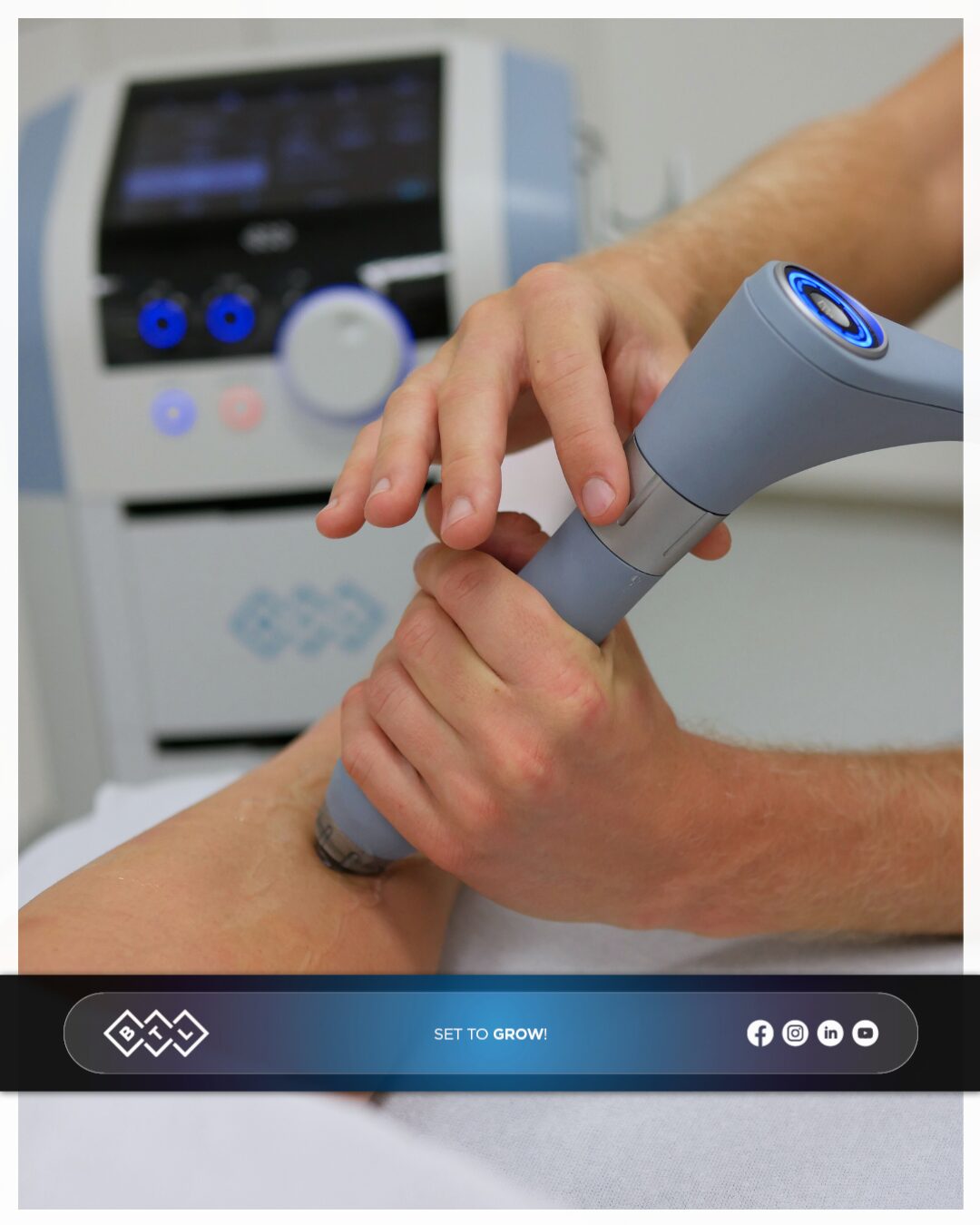
Achilles Tendinopathy
BTL-6000 SWT · Five Dock
What is Achilles Tendinopathy?
The Achilles tendon is the largest and strongest tendon in the body, connecting the calf muscles to the heel bone. It transmits enormous forces during walking, running, and jumping — and is consequently one of the most commonly injured tendons in active individuals.
Achilles tendinopathy refers to a degenerative condition of the tendon characterised by pain, stiffness, and reduced function. Like plantar fasciitis, it is not primarily an inflammatory condition in its chronic form — the tendon undergoes structural disorganisation and degeneration, which is why anti-inflammatory approaches have limited long-term effect.
There are two distinct presentations of Achilles tendinopathy, each with slightly different clinical characteristics and treatment considerations.
Type 1
Mid-Portion Tendinopathy
Pain and thickening located 2–6cm above the heel bone insertion. The most common presentation, particularly in runners. Responds well to progressive loading programs and shockwave therapy.
Type 2
Insertional Tendinopathy
Pain at the point where the tendon attaches to the heel bone. Often associated with a Haglund’s deformity (bony prominence). Requires a modified loading approach and responds well to shockwave.
Common Symptoms
Achilles tendinopathy has a recognisable symptom pattern. If these sound familiar, shockwave may be worth discussing.
Morning stiffness and pain in the AchillesStiffness and pain with the first steps after rest — particularly in the morning — that warms up with activity but may return after prolonged loading.
Pain during or after running and activityA classic pattern of pain that begins after a certain volume of running, and worsens progressively if training continues without modification.
Localised tenderness along the tendon or at the heelPoint tenderness either along the mid-portion of the tendon or directly at its insertion into the heel bone, depending on the type of tendinopathy.
Tendon thickening or noduleA visible or palpable thickening of the tendon — particularly in mid-portion presentations — indicating structural change within the tendon tissue.
Symptoms persisting despite rest or stretchingIf the tendon hasn’t responded to load reduction and conservative management, shockwave combined with a progressive loading program is a clinically supported next step.
Why Shockwave for Achilles Tendinopathy?
Shockwave therapy is one of the most well-researched non-surgical treatments for Achilles tendinopathy, with strong evidence supporting its use — particularly for chronic mid-portion presentations.
Mechanism
Stimulates Tendon Healing
Chronically degenerated Achilles tendon tissue lacks adequate blood supply and has undergone structural disorganisation. Shockwave stimulates neovascularisation and collagen synthesis — the two key drivers of tendon tissue repair — restarting the healing process.
Evidence Base
Supported by RCTs and Systematic Reviews
Multiple randomised controlled trials and systematic reviews support shockwave therapy for chronic Achilles tendinopathy, particularly mid-portion presentations. Evidence for insertional tendinopathy is also growing, with shockwave often preferred over other non-surgical options.
Mid-Portion vs Insertional
Effective for Both Types
Shockwave is appropriate for both mid-portion and insertional Achilles tendinopathy, though the treatment parameters and accompanying exercise program differ between the two. We tailor the approach based on your specific presentation.
Our Approach
Shockwave + Heavy Slow Resistance Training
The strongest evidence for Achilles tendinopathy combines shockwave with a heavy slow resistance (HSR) loading program — progressive heel raises performed with controlled tempo and significant load. This is how we treat at SportsFit, and the research supports it.
Book a Free Call
Achilles Shockwave at SportsFit
Watch shockwave treatment applied to the calf and Achilles at our Five Dock clinic.
How We Treat Achilles Tendinopathy
The evidence is clear — shockwave alone is not the complete answer for Achilles tendinopathy. The loading program is essential. Here’s how we structure treatment.
01
Assessment & Classification
We assess the location (mid-portion vs insertional), severity, symptom duration, and contributing factors including calf strength, ankle mobility, training load, and footwear. Distinguishing between mid-portion and insertional presentations is clinically important as it changes both the shockwave technique and the exercise prescription.
02
Shockwave Treatment
Using the BTL-6000 SWT, we apply targeted shockwaves to the affected portion of the tendon. For mid-portion tendinopathy, we treat along the tendon body. For insertional presentations, the approach is modified to account for the bony attachment and the different load characteristics at that site. A typical course involves 3–6 sessions spaced one week apart.
03
Heavy Slow Resistance Loading — The Key Component
Alongside shockwave, we prescribe a progressive heel raise program using heavy slow resistance principles. This means performing controlled, loaded calf raises through a full range — progressing the load systematically over weeks. For mid-portion tendinopathy, this includes exercises through full range. For insertional presentations, range is modified to avoid compressive loading at the heel.
04
Running Load Management
If you’re a runner, we’ll work with you to maintain as much running as possible during treatment — rather than stopping altogether. We use symptom monitoring guidelines to guide your training volume and intensity, progressing your load as the tendon responds.
05
Return to Full Training
Once the tendon has responded to shockwave and established a solid loading base, we transition to sport-specific training with a structured return-to-running or return-to-sport plan. We don’t discharge you the moment symptoms settle — we make sure the tendon is robust enough to handle your full training load.
Why Exercise is Non-Negotiable
Tendons respond to load. Shockwave creates the stimulus for healing — but the tendon needs progressive loading to reorganise the new tissue and build capacity. Skipping this step produces short-term relief without long-term durability.
Phase 1 — Weeks 1–2
Isometric Loading
Sustained calf contractions against resistance, held for 30–45 seconds. These reduce tendon pain rapidly and can be performed even when symptomatic. A useful tool for managing discomfort during the early treatment phase, particularly before activity.
Phase 2 — Weeks 2–8
Heavy Slow Resistance
Progressive double and single-leg heel raises performed with a slow, controlled tempo (3 seconds up, 3 seconds down). Load is increased systematically. This is the most evidence-supported exercise intervention for Achilles tendinopathy and forms the core of the program.
Phase 3 — Weeks 6+
Energy Storage & Return
Progressive plyometric loading — hopping, bounding, and running-specific drills — that prepares the tendon for the elastic demands of sport and running. Progressed based on symptom response and strength benchmarks.
Important note on insertional tendinopathy: The exercise program for insertional Achilles tendinopathy differs from mid-portion. Exercises that load the tendon in a stretched position (e.g. heel raises off a step) can aggravate insertional presentations due to compressive forces at the bone-tendon junction. We modify the program accordingly — this is one of the most common mistakes we see from self-directed rehab programs.
Key Studies & Evidence
The following peer-reviewed publications support shockwave therapy for Achilles tendinopathy. We encourage patients to read the research.
Systematic Review & Meta-Analysis · PubMed 2023
Shockwave therapy for Achilles, patellar, and plantar tendinopathy
A systematic review and meta-analysis examining the effectiveness of shockwave therapy across three major tendinopathies including Achilles. Found clinically meaningful improvements in pain and function for chronic Achilles tendinopathy.
View on PubMed →
Narrative Review · PMC 2022
Combined ESWT and exercise for tendinopathy
A narrative review examining the evidence for combining shockwave with exercise programs for tendinopathy — the clinical rationale for our combined approach. Published in Sports Medicine and Health Science.
View on PMC →
Systematic Review · PubMed 2020
ESWT update — mechanisms and clinical applications
A comprehensive update on shockwave therapy covering biological mechanisms and clinical evidence across musculoskeletal conditions including Achilles tendinopathy. Published in EFORT Open Reviews.
These references are provided for informational purposes. Individual responses to treatment vary. This information does not constitute medical advice — please consult a qualified physiotherapist to determine whether shockwave therapy is appropriate for your condition.
FAQ — Achilles Tendinopathy & Shockwave
Can I keep running while having shockwave for my Achilles?
In most cases, yes — with guided load modification. We use a symptom-monitoring approach to help you maintain as much running as possible during treatment. We’ll advise you to reduce intensity in the 24–48 hours after each shockwave session, but complete rest is rarely the right approach for tendinopathy.
What’s the difference between mid-portion and insertional Achilles tendinopathy?
Mid-portion tendinopathy involves degeneration within the body of the tendon, typically 2–6cm above the heel. Insertional tendinopathy occurs at the point where the tendon attaches to the heel bone. Both respond to shockwave, but the exercise program — particularly the range of motion used for loading — differs significantly between the two. Getting this distinction right matters clinically.
How many shockwave sessions will my Achilles need?
A typical course involves 3–6 sessions spaced one week apart. Response varies depending on symptom duration, the type of tendinopathy, and how well the loading program is progressed alongside treatment. We reassess throughout and will give you a realistic picture at your first appointment.
I’ve been told to stretch my Achilles — is that right?
It depends. Stretching can be appropriate for mid-portion tendinopathy as part of a broader program, but for insertional presentations, aggressive calf stretching can actually aggravate symptoms by compressing the tendon at the heel. This is one of the most common self-management errors we see. We’ll advise you specifically based on your presentation.
Do I need a referral?
No referral needed. Book directly online for a free phone call or an initial appointment. We’ll assess your Achilles and determine the most appropriate treatment approach at your first visit.
Not Sure If Shockwave Is Right for Your Achilles?
Book a free call with one of our physios. We’ll ask about your symptoms and give you an honest answer about whether shockwave is appropriate — no obligation to proceed.
Already decided? Book an appointment directly →
No referral needed · Five Dock, Inner West Sydney · Health fund rebates available
Related Conditions
Chronic heel and arch pain resistant to rest and stretching.
Jumper’s knee — anterior knee pain limiting sport and activity.
Shoulder
Rotator Cuff Tendinopathy
Calcific and non-calcific shoulder tendinopathy causing pain and restricted movement.
Hip & Gluteal
Proximal Hamstring Tendinopathy
Deep buttock pain worsened by sitting, hills, and speed work.
Lateral elbow pain affecting grip strength and daily activities.
Five Dock — Shockwave Clinic
164 Great North Road, Five Dock NSW 2046 · (02) 8054 3775